
The question
Glass at bending temperature can take double curvature. A flat PET film cannot stretch the same way during lamination: to follow a double-curved shape, it has to absorb differences in length, and the edges of the film are where this is hardest. Wrinkling of PET-based films in curved laminates is a known difficulty, and roofs, which are often strongly curved in both directions, are directly concerned.
The design question is practical: for a given roof shape, how large can the film be, and where would wrinkles form first?
Our approach
We simulate the lamination itself, not only the final geometry:
- One generic double-curved roof surface, kept identical for both cases;
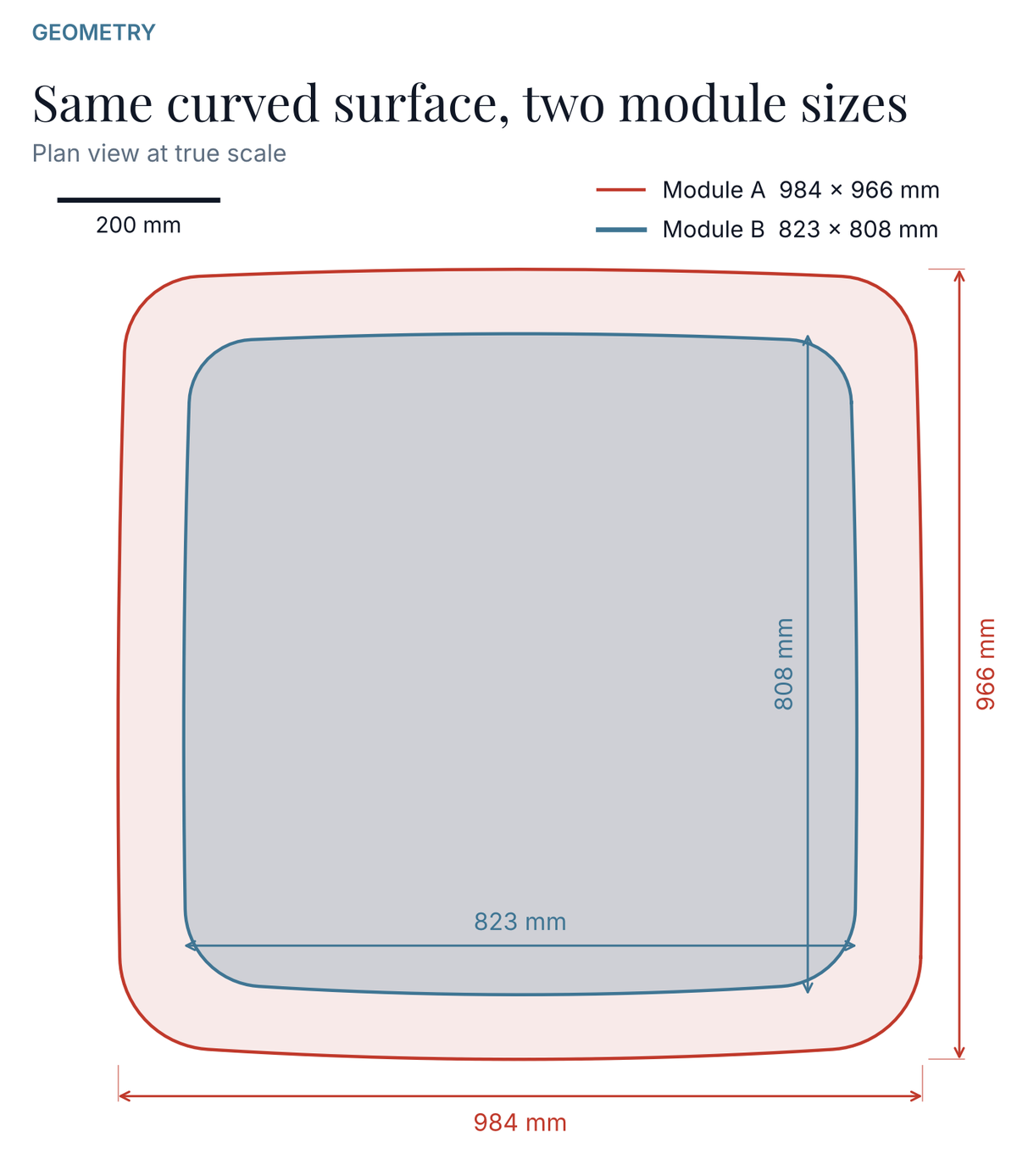
- Two film modules with the same outline shape: module A (984 × 966 mm) and a smaller module B (823 × 808 mm);
- Material models for the film and the interlayers, through the lamination cycle;
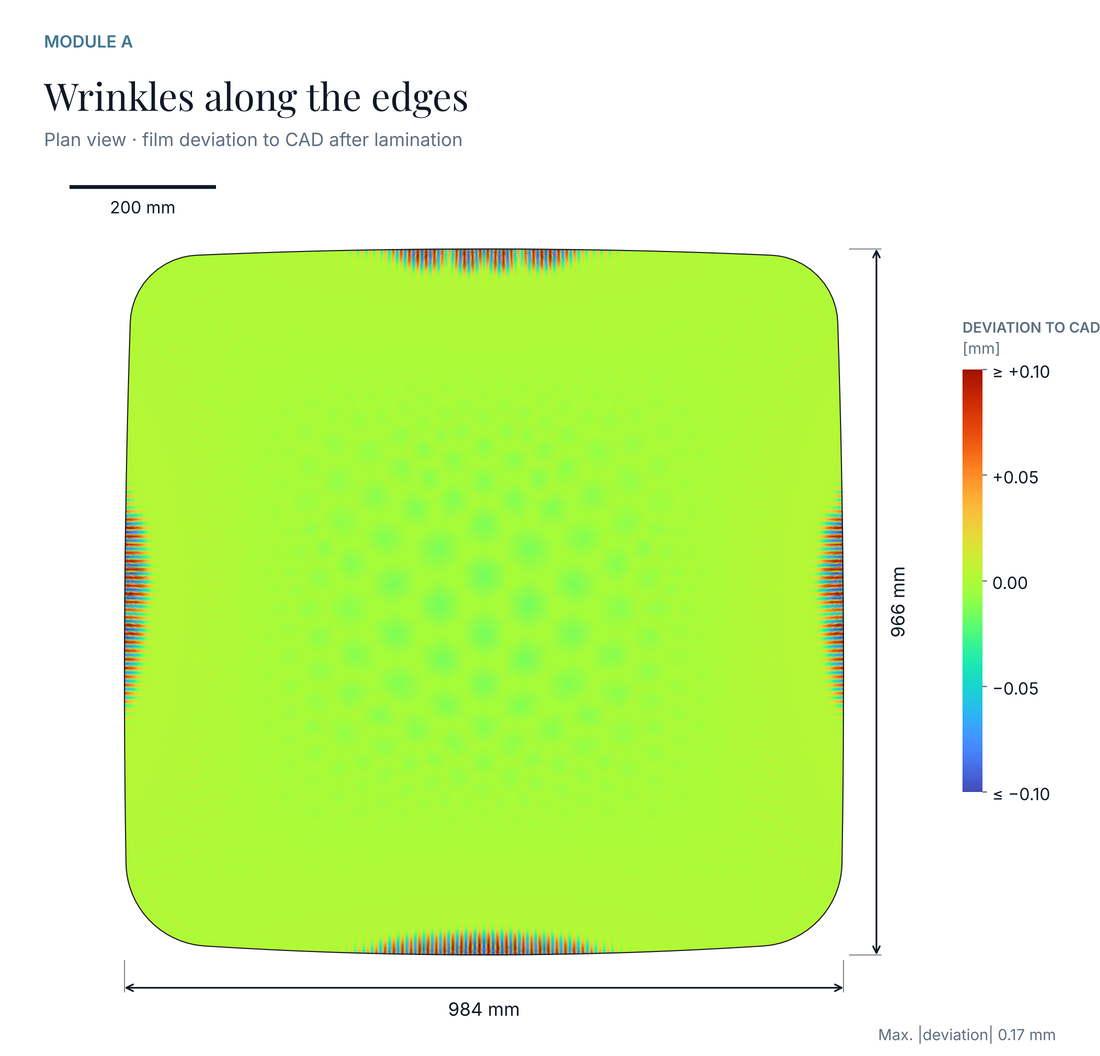
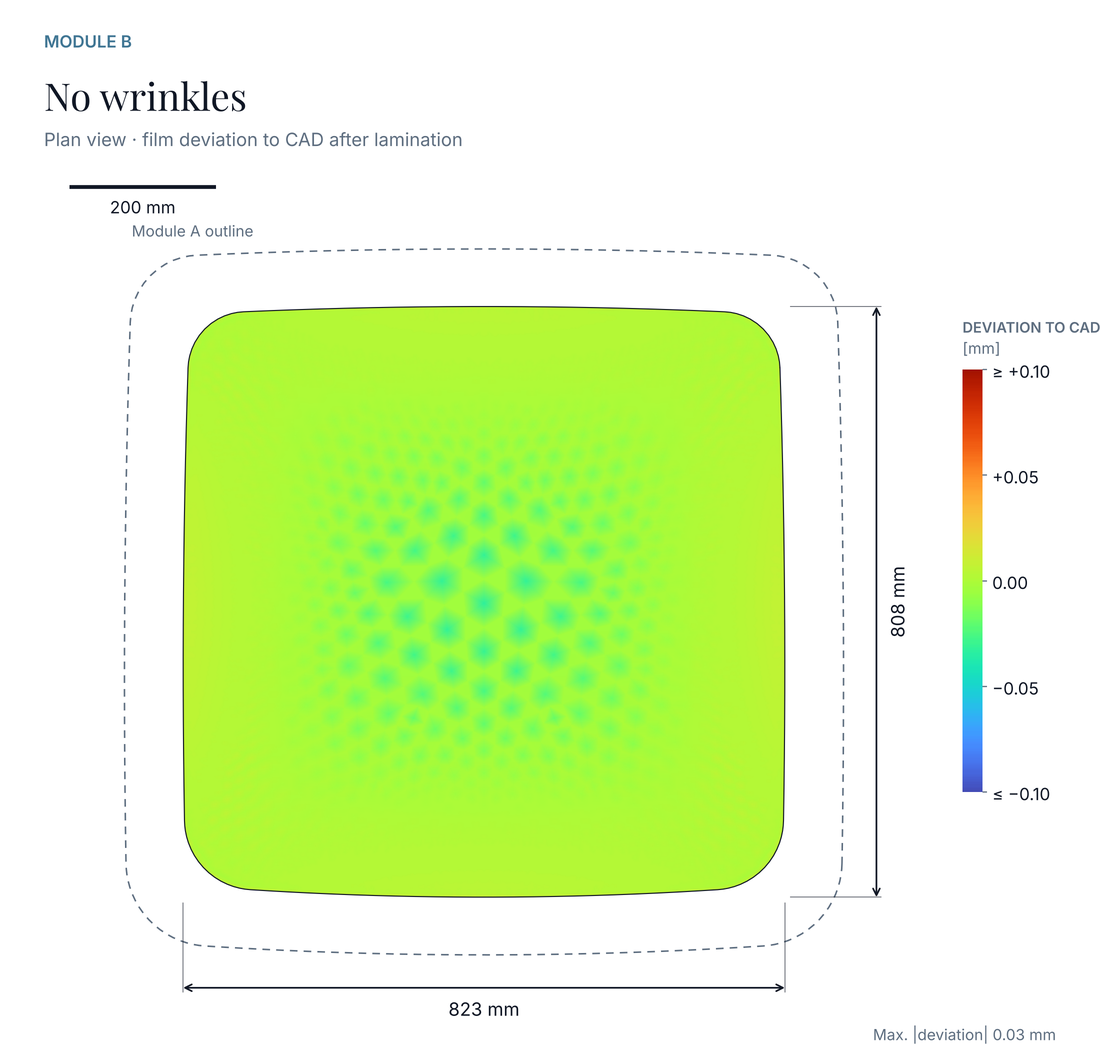
- For each module: the deviation of the film from the CAD surface after lamination, shown in plan view.
For multi-layer film products such as PDLC, the results give an early view of where wrinkles are most likely.
Results
On this roof shape, module B follows the glass: after lamination, the film stays close to the CAD surface everywhere, without wrinkles.
Module A, larger, wrinkles. The wrinkles concentrate in the middle of its four edges, while the centre of the film still follows the glass.
Comparing the two sizes on the same shape shows where the limit lies for this roof. Intermediate sizes or adapted outlines can be evaluated the same way, before ordering film samples and running trials. Seeing the film shape after lamination makes the result easy to discuss with design, process and film suppliers.
Key takeaway
Simulating the lamination of PET-based films shows early which film sizes a curved roof can accept, and where wrinkles would form first.
Forming simulation for PET-based interlayers
Plan functional film integration earlier: simulate PET-based films through lamination and see where wrinkles may appear, for switchable films such as PDLC.
CapabilityLamination simulation
Evaluate lamination stress and shape changes: simulate how glass plies and interlayers behave during lamination, for symmetric, asymmetric or cold-bent stacks.